Claude Fable 5: What Changed, When to Use It, and How It Compares to Opus 4.8
My practical read on Claude Fable 5: not a new default model for everything, but a premium escalation tier for the work where Opus is no longer enough.
Anthropic positions Claude Fable 5 as its most capable generally available Claude model. That sounds like a normal model announcement, but the important question is more boring and more useful:
When would I actually pay for it?
For many teams, Opus has been the top-tier default when Sonnet was not enough. Fable 5 changes that slightly. It gives Anthropic a more expensive tier above Opus for the tasks where reasoning quality, long context, and agent reliability matter more than token price.
That does not mean I would route everything to Fable.
The better pattern is probably:
- Sonnet for normal production workloads
- Opus for harder reasoning and coding tasks
- Fable for the few tasks where the premium is visible in the result
That last part matters. If the output is not better, the model is just more expensive.
Note: this article is based on Anthropic's public documentation as of June 2026. Pricing and availability can change, so treat the numbers as a snapshot.
The short version
Fable 5 is interesting for three reasons.
First, Anthropic positions it above Opus for demanding reasoning and long-horizon agent work.
Second, it supports a very large context window and long outputs. That opens useful workflows, but it also makes it easy to spend money accidentally.
Third, there are production details developers need to handle properly: refusals, fallback routing, adaptive thinking, billing and telemetry.
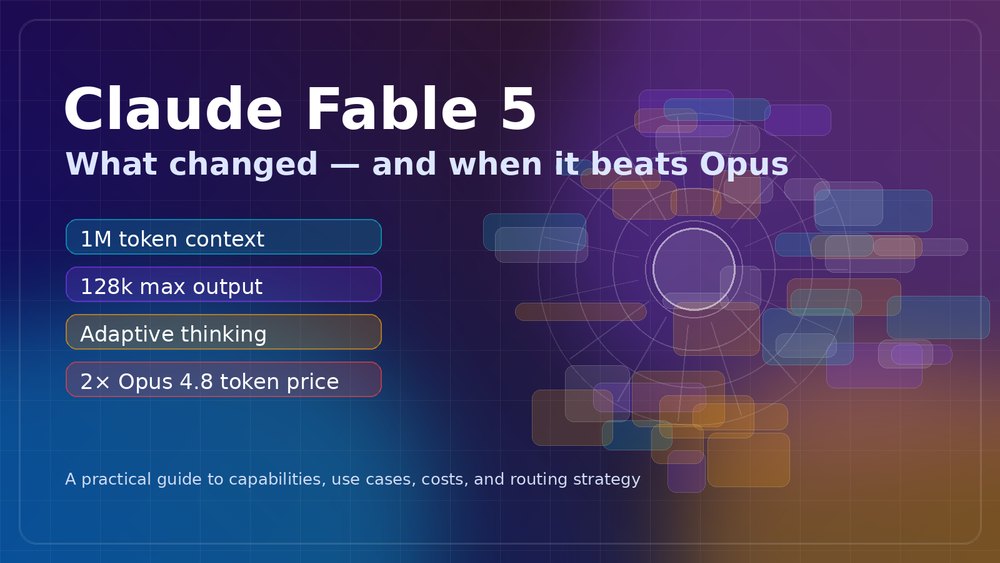
The catch is simple: Fable 5 costs twice as much as Opus 4.8 on base token pricing.
So the decision is not "which model is better?". The decision is:
Which tasks are expensive enough when they fail that Fable is worth the premium?
What Fable 5 is for
The API model ID is:
claude-fable-5
Anthropic describes it as a model for difficult reasoning, long-horizon agentic workflows, large context workloads, complex tool use, and high-value work where quality matters more than marginal token cost.
There is also Claude Mythos 5, which shares the same core capabilities and pricing but is limited availability through Project Glasswing. For most teams, Fable 5 is the one they would evaluate first.
I would think of Fable as an escalation model. Not the model you call because it is new, but the model you call after cheaper models stop being good enough.
The technical changes that matter
Large context by default
Fable 5 supports a 1 million token context window by default.
That can change the architecture for some workflows. Older context limits often forced chunking, retrieval, summarization, or multi-step document processing. With a larger context window, some of those workflows become simpler.
Good candidates:
- reviewing a large codebase section
- analyzing long legal or compliance document sets
- reconstructing a multi-day incident timeline
- reading a large customer support history
- comparing many research papers or specifications
- running an agent with a long execution trace
But I would not blindly paste everything into the prompt. A huge context can still be noisy, slow and expensive. Bigger context does not remove the need for good retrieval, source selection and evaluation.
Long output is useful, and dangerous
Fable 5 can generate up to 128k output tokens in one request.
That is useful for migration plans, structured reports, document conversion, code review findings or detailed test plans.
It is also where costs can surprise you. Output tokens are usually the expensive side of the bill. If an app lets the model produce huge answers by default, the first cost review will be unpleasant.
I would set output limits per use case instead of giving every workflow the maximum.
Adaptive thinking needs cost awareness
Fable 5 uses adaptive thinking as its thinking mode. Earlier patterns where you explicitly disable thinking do not apply the same way. Anthropic exposes an effort parameter to control depth.
For developers, this matters because a "simple" request and a "deep reasoning" request are no longer only prompt design questions. They are routing, latency and cost questions.
If your app has mixed workloads, route simple tasks to cheaper models. Do not make Fable the endpoint for everything just because it is the strongest model.
Do not rely on raw chain of thought
Fable 5 does not return raw chain of thought. Depending on configuration, thinking blocks may contain a readable summary or an omitted/empty thinking field.
That is fine for production systems. Applications should not rely on hidden internal reasoning anyway.
If you need auditability, log the parts you can actually use:
- inputs
- retrieval sources
- tool calls
- model outputs
- validation results
- confidence signals
- correlation IDs
That is more useful than pretending raw chain of thought is a proper audit log.
Refusal handling belongs in normal control flow
This is an easy footgun.
When Claude Fable 5 refuses a request, the Messages API can return an HTTP 200 response with:
stop_reason: "refusal"
So refusal handling cannot live only in your exception handler. HTTP 200 does not automatically mean the model completed the business task.
Your application has to inspect the response body and decide what happens next:
- show a safe user-facing message
- ask for clarification
- stop the workflow
- route to a fallback model if your policy allows it
- log the refusal as part of task state
This is boring integration work, but it prevents messy production behavior.
Fable 5 vs Opus 4.8
Opus 4.8 is still a strong high-end model. It is designed for complex reasoning, agentic coding and high-autonomy work. It also supports a large context window and long outputs.
The practical difference is positioning and price.
Anthropic positions Fable 5 as the premium tier above Opus. That means Fable has to earn its place through better outcomes, not just better benchmark language.
Pricing snapshot
| Model | Input | Output | 5 min cache write | 1 hour cache write | Cache read |
|---|---|---|---|---|---|
| Claude Fable 5 | $10 / MTok | $50 / MTok | $12.50 / MTok | $20 / MTok | $1 / MTok |
| Claude Opus 4.8 | $5 / MTok | $25 / MTok | $6.25 / MTok | $10 / MTok | $0.50 / MTok |
Fable is exactly 2x the base token price of Opus.
Batch pricing follows the same pattern:
| Model | Batch input | Batch output |
|---|---|---|
| Claude Fable 5 | $5 / MTok | $25 / MTok |
| Claude Opus 4.8 | $2.50 / MTok | $12.50 / MTok |
Quick cost examples
Assume a request uses 200k input tokens and 20k output tokens.
With Fable 5:
Input:  200,000 × $10 / 1,000,000 = $2.00
Output:  20,000 × $50 / 1,000,000 = $1.00
Total: $3.00
With Opus 4.8:
Input:  200,000 × $5 / 1,000,000 = $1.00
Output:  20,000 × $25 / 1,000,000 = $0.50
Total: $1.50
For one important request, that difference may not matter. At scale, it absolutely does.
For a batch job with 100 million input tokens and 10 million output tokens:
Fable 5 batch:    (100 × $5)    + (10 × $25)    = $750
Opus 4.8 batch:   (100 × $2.50) + (10 × $12.50) = $375
So the routing question is simple: does Fable reduce failures, review time or rework enough to justify double the price?
Where I would use Fable 5
Hard coding work
Fable makes sense for software tasks where the model has to stay coherent for a long time:
- large refactors
- multi-file architectural changes
- deep bug hunts
- migration planning
- dependency upgrade analysis
- codebase-wide security remediation
I would not use it for small edits. For everyday coding, cheaper models are usually enough. But for a migration where a bad plan wastes days of senior engineering time, Fable can be justified.
Long-context document work
The large context window is useful when the model needs to keep many documents in view:
- contract review
- procurement comparisons
- compliance gap analysis
- audit preparation
- technical due diligence
- large specification sets
The prompt still needs structure. "Read everything and tell me what you think" is not enough.
Ask for concrete findings, citations, risk categories, unknowns and follow-up questions.
Incident analysis
Incident response is messy. Logs, alerts, chat messages, deployment notes, ticket comments and dashboards rarely line up cleanly.
A useful workflow could be:
- collect the timeline
- ask Fable to identify likely causal chains
- extract uncertainty and missing evidence
- draft the postmortem
- let humans correct it before publishing
The model should not be the final authority. It should help humans see the incident more clearly.
Research synthesis
For research-heavy teams, Fable can sit on top of a large corpus:
- literature reviews
- policy analysis
- market research
- competitive intelligence
- internal knowledge synthesis
This is most valuable when the hard part is not finding one source, but reconciling many sources that only partly agree.
Complex support escalations
Most support tickets do not need Fable.
But escalations can involve long histories, previous failed fixes, account-specific rules and policy constraints. That is where an escalation tier makes sense.
A sane routing setup could be:
- Haiku or Sonnet for classification and simple replies
- Opus for advanced troubleshooting
- Fable only for difficult escalations or important accounts
That is much cheaper than sending every ticket to the premium model.
Example: refusal handling and fallback
A production integration should treat refusal as a normal model result:
from anthropic import Anthropic

client = Anthropic()

response = client.messages.create(
    model="claude-fable-5",
    max_tokens=4000,
    messages=[
        {"role": "user", "content": "Analyze this customer escalation and draft a reply..."}
    ],
)

if response.stop_reason == "refusal":
    # This is not an HTTP exception.
    # It is a successful API response with a refusal state.
    fallback = client.messages.create(
        model="claude-opus-4-8",
        max_tokens=4000,
        messages=[
            {"role": "user", "content": "Analyze this customer escalation and draft a reply..."}
        ],
    )
    result = fallback
else:
    result = response
In a real system, I would not hardcode this inside business logic. Put model routing, refusal handling, fallback policy and billing telemetry behind a gateway or model layer. Then you can change model choices later without editing every workflow.
When Fable is worth the money
Use Fable when one of these is true:
- Opus is not reliable enough for the task.
- A wrong answer is expensive.
- The context is genuinely large.
- The workflow runs for many agent steps.
- The output needs deep synthesis, not just summarization.
- Human review time is more expensive than the model premium.
Good examples:
- "Find the root cause across this full incident timeline."
- "Review this migration plan and identify hidden risks."
- "Compare these contracts and flag non-standard clauses."
- "Synthesize this research corpus with explicit uncertainty."
- "Plan a modernization project from legacy system documentation."
When Opus is probably the better default
Use Opus 4.8 when the task is complex, but not extreme:
- normal agentic coding
- architecture review
- medium-sized document analysis
- internal assistants
- planning tasks
- advanced troubleshooting
For many teams, the boring routing strategy is the right one:
- Start with Sonnet for most production workloads.
- Escalate to Opus for complex reasoning.
- Escalate to Fable only when Opus is not good enough or the economics justify it.
Boring routing is usually how you keep AI costs under control.
My take
Claude Fable 5 is not a drop-in replacement for Opus. I would not make it the default model just because it is the strongest one.
The important parts are operational: refusal handling, fallback behavior, prompt caching economics, adaptive thinking, output limits and the fact that Fable costs twice as much as Opus 4.8.
If I were adding it to a production stack, I would introduce it as an escalation tier and measure outcomes. Does it solve more tasks? Does it reduce review time? Does it avoid rework? Does it produce better results on the cases where Opus struggles?
If yes, use it there.
If not, keep the money.
Sources
- Anthropic Docs: Models overview: https://platform.claude.com/docs/en/about-claude/models/overview
- Anthropic Docs: Introducing Claude Fable 5 and Claude Mythos 5: https://platform.claude.com/docs/en/about-claude/models/introducing-claude-fable-5-and-claude-mythos-5
- Anthropic Docs: Claude pricing: https://platform.claude.com/docs/en/about-claude/pricing
- Anthropic Docs: What's new in Claude Opus 4.8: https://platform.claude.com/docs/en/about-claude/models/whats-new-claude-4-8