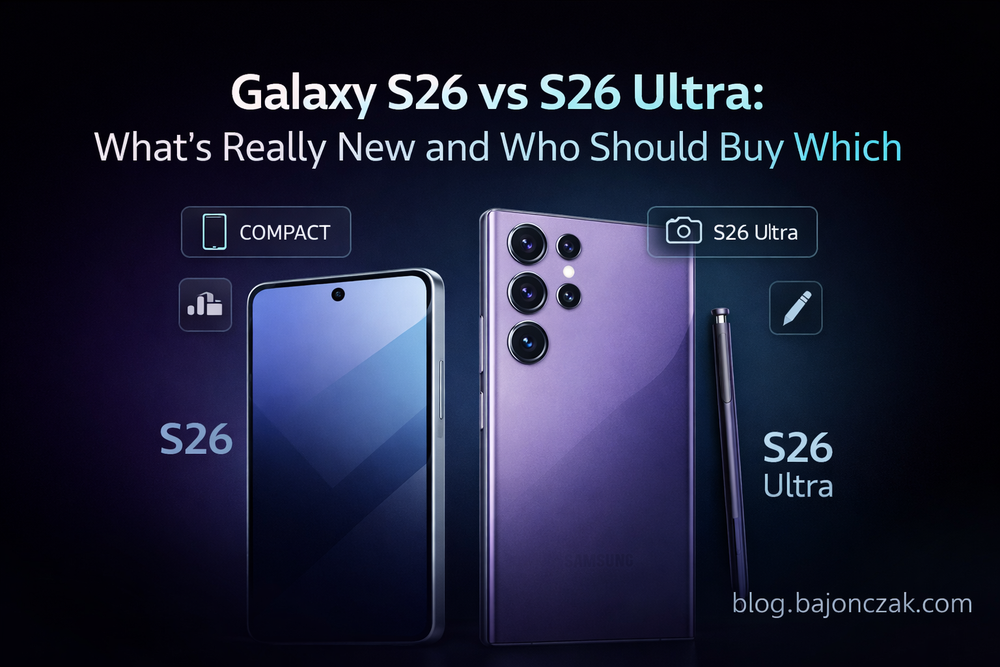
Galaxy S26 vs S26 Ultra: What’s Really New and Who Should Buy Which
Samsung’s Galaxy launch cycle has become pretty predictable over the years: three flagship phones, same naming scheme, lots of leaks, a big Unpacked event – and then the real question:
Which one of these devices actually makes sense for me?
With the Galaxy S26 and S26 Ultra, the pattern continues. The Ultra is once again the spec monster, the regular S26 is the smaller, more pocket‑friendly version – and the headlines this year are less about raw hardware jumps and more about Samsung’s push around “Galaxy AI”.
In this post I want to walk through:
- what has actually changed compared to the previous generation,
- the main differences between S26 and S26 Ultra,
- and for which kind of user each device makes sense.
This is not a lab review – it’s a practical look from someone who cares about everyday use and long‑term value more than synthetic benchmarks.
What’s new in the S26 generation overall?
Looking at early reports and hands‑on impressions, a few themes stand out:
- Galaxy AI is front and centre.
Samsung is doubling down on AI‑branded features: advanced photo editing (“Photo Assist”), smarter transcription and summarisation, on‑device suggestions, and tighter integration of AI into system apps. - Refinements over revolution.
The S26 series doesn’t radically change the formula. Screens, cameras and overall design feel like measured iterations over the S25 line rather than a complete redesign. - Focus on thermals and efficiency.
There are rumours about a move away from titanium in favour of an updated aluminium frame (“Armor Aluminum 2.0”) for the S26 series, with better thermal management and slightly lower weight as the main reasons.
If you were hoping for a wild new form factor or a completely different camera setup, this is not that year. The interesting part is in the details – and in how Samsung positions the regular S26 vs the S26 Ultra.
Galaxy S26 vs S26 Ultra: the headline differences
Without getting lost in every minor spec, here’s how I’d summarise the core differences that matter in daily use.
Size, screen and pen
The pattern is familiar:
- Galaxy S26: smaller, easier to handle one‑handed, still with a high‑quality display, but not the biggest panel in the line‑up.
- Galaxy S26 Ultra: the big canvas – larger display, higher brightness and often slightly better panel specs, plus the usual boxier design.
The Ultra also keeps the S Pen story alive. If you like scribbling notes directly on the screen, marking up screenshots or doing quick sketches, the Ultra remains the only choice in the S26 family that really caters to that use case.
Cameras
According to early coverage, the S26 Ultra sticks with a similar camera hardware configuration as its predecessor:
- 200 MP main sensor,
- 50 MP ultrawide,
- dual telephoto setup with different optical zoom levels.
The regular S26 gets a more standard flagship camera package: plenty good for most people, but without the Ultra’s full telephoto flexibility and headline megapixel numbers.
The more interesting story this year is less about raw camera hardware and more about what Galaxy AI does on top of it:
- smarter scene detection,
- more powerful AI‑based editing (removing objects, recomposing photos, upscaling),
- and potentially better low‑light performance through improved processing rather than new sensors.
Performance and thermals
Both S26 and S26 Ultra run on the latest generation of Samsung’s chosen SoC (details vary by region as always). For everyday tasks, you’re unlikely to feel a huge difference between them.
Where the Ultra tends to pull ahead is:
- sustained performance over longer, heavy workloads (gaming, 4K video, extended camera use),
- and slightly better thermal behaviour thanks to a larger chassis and more room for cooling.
If rumours about the return to an optimised aluminium frame pan out, that should also help with moving heat out of the device more quickly compared to last year’s titanium frame.
Battery and endurance
Again, the Ultra plays the “bigger phone, bigger battery” card. For most light to moderate users, the regular S26 will be fine for a full day. The Ultra gives you more headroom if you:
- travel a lot,
- watch a lot of video or game on your phone,
- or hammer the camera and AI features throughout the day.
What feels genuinely new vs. S25?
On the hardware side, the S26 generation feels more like a refinement pass than a revolution. The things that stand out as “newish” or at least more prominent are:
- Galaxy AI as a first‑class story.
The branding and feature focus make it clear Samsung sees AI as a differentiator now, not an add‑on. - Thermal and material tweaks.
If the move to an updated aluminium frame is confirmed, that’s a subtle but important shift in how the devices behave under load. - More integrated AI workflows.
Deeper tie‑in of AI into camera, messaging, notes, transcription and assistance flows – especially on the Ultra, where people expect the “full package”.
In short: if you’re coming from an S24 or even S25, the question is less “are the specs higher?” and more “do I care enough about the new AI features, thermals and refinements to justify the upgrade?”
Who the Galaxy S26 is for
When I look at the regular S26, I picture:
- someone who wants a high-end phone that doesn’t feel huge,
- doesn’t care about the S Pen,
- and mostly uses the camera for everyday shots, social media and occasional travel photos.
It’s the “default flagship” for people who like Samsung’s ecosystem and design, but don’t want a brick in their pocket.
In other words:
- most professionals,
- students,
- and anyone upgrading from an older mid‑range or flagship device who doesn’t need the Ultra’s extra features.
Who the Galaxy S26 Ultra is for
The S26 Ultra continues to be the “no compromise (and no small pockets)” option.
I see it as a good fit for:
- power users who live on their phone – productivity, media, multitasking, lots of browser and app use,
- note‑takers and scribblers who actually use the S Pen for annotations, quick sketches, marking up PDFs,
- camera enthusiasts who want the extra telephoto flexibility and are willing to carry the bigger device for it.
If your phone is effectively your main computer on the go, the Ultra still makes sense. If you mostly message, call, scroll and take a few photos, the regular S26 will probably hit the sweet spot more comfortably.
Should you upgrade from an older device?
Very rough guidance, based on how I’d think about it personally:
- From an S25 / S25 Ultra: only if you really care about the latest AI features, subtle thermal improvements, or you simply like having the newest thing.
- From an S23 or older: the S26/S26 Ultra will feel like a clear upgrade in camera performance, AI features and long‑term software support.
- From a mid‑range device: both S26 models will be a big step up; choose based on size and whether you’ll actually use the S Pen and extra camera options.
My take
The Galaxy S26 generation is not the year of wild experimentation. It’s the year of:
- polishing the hardware,
- leaning hard into AI as a selling point,
- and making small but meaningful changes that matter over two to three years of use.
If you like Samsung’s approach and you’re ready to upgrade, the real question is simple:
- Do you want the smaller, more balanced flagship (S26)?
- Or do you want the big, pen‑enabled, spec‑heavy version (S26 Ultra)?
As always, the best choice depends less on the spec sheet and more on how you actually live with your phone day to day.